Grid Reliability
What "grid independence" actually means for a residential home
Grid independence is one of those phrases that sounds powerful but means different things to different people. Some imagine a fully off-grid cabin in the mountains. Others picture a suburban home that never receives a utility bill. The reality for most homeowners is somewhere in between — and understanding the spectrum matters.
True off-grid living means zero connection to the utility. No power lines, no meter, no relationship with the electricity provider whatsoever. Everything the home needs is generated and stored on-site.
This is technically possible but rarely practical for residential homes in urban or suburban settings. It requires oversized solar arrays, massive battery banks, backup generators for extended low-production periods, and significant lifestyle adjustments during winter or cloudy stretches.
Grid independence, by contrast, means something more nuanced. The home remains physically connected to the grid but relies on it minimally. It generates the majority of its own power, stores excess for later use, and draws from the grid only when absolutely necessary.
The grid connection becomes a safety net rather than a lifeline.
This distinction matters because grid independence is achievable for most homes without extreme cost or compromise. True off-grid living is a different project entirely.
The 80% threshold
Most well-designed solar-battery systems in favorable climates can achieve 70% to 90% grid independence within their first year of operation.
That means the home generates and consumes its own energy for the vast majority of hours across the year. Grid power fills the gaps — typically during extended cloudy periods, extreme consumption events, or deep winter months with reduced solar production.
The jump from 80% to 100% independence is exponentially more expensive than the jump from 0% to 80%. Eliminating that last 20% of grid reliance requires disproportionately more battery capacity and solar production to cover the worst-case scenarios.
For most homeowners, 80% to 90% independence delivers the optimal balance of savings, protection, and investment. The remaining grid usage costs relatively little and provides a comfortable buffer without requiring massive over-investment.

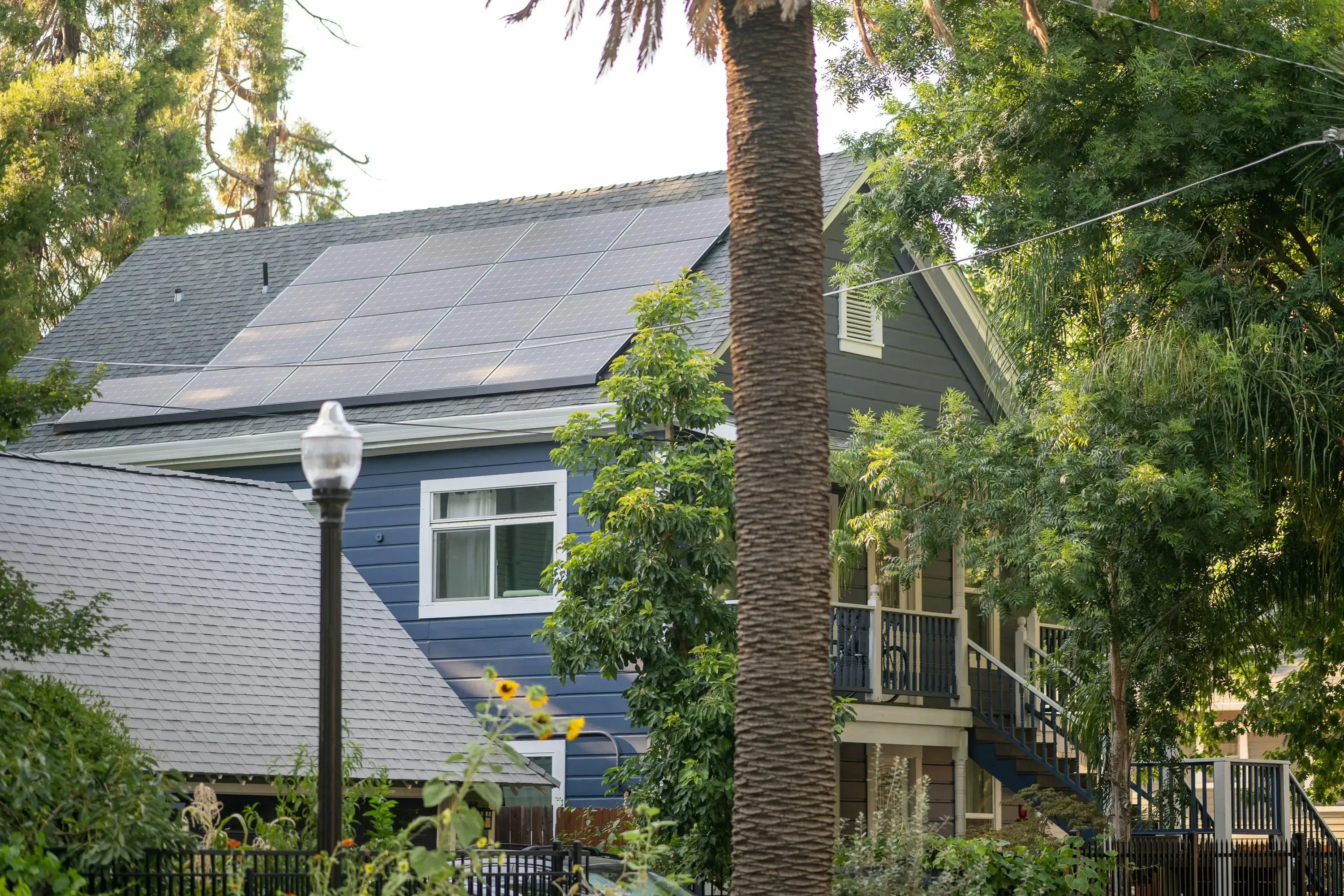
This is image caption.
What grid independence feels like day to day
The practical experience of living in a grid-independent home is surprisingly unremarkable.
Lights turn on. Air conditioning runs. The refrigerator hums. Devices charge. Dinner gets cooked. The EV charges overnight. Everything functions exactly as it always has.
The only visible difference is the monitoring dashboard showing where the power comes from — solar production, battery storage, or grid import — in real time.
On a typical sunny day, the home runs entirely on self-generated power from morning through evening. The battery handles overnight needs. The grid might contribute a few kilowatt-hours during a stretch of heavy cloud cover or an unusually high consumption event.
The homeowner doesn't manage any of this. The system handles production, storage, and grid interaction automatically based on programmed priorities.
Grid independence doesn't feel like sacrifice or complexity. It feels like a normal home that happens to pay almost nothing for electricity.
Financial independence from the utility
The financial dimension of grid independence is often more impactful than the technical one.
When a home generates 80% or more of its own energy, the monthly utility bill drops to a fraction of its former level. In many cases, the remaining charges are primarily fixed connection fees rather than consumption costs.
This creates financial predictability that grid-dependent homes simply cannot achieve. Utility rate increases, seasonal price spikes, and demand charges all become largely irrelevant when the home barely draws from the grid.
Over a 25-year system lifespan, this stability translates into tens of thousands of dollars in avoided costs — money that would otherwise have been spent on utility bills that increase every year with no end date.
Grid independence isn't just about where the electrons come from. It's about removing the home's largest uncontrollable recurring expense and replacing it with a fixed, predictable, self-generating asset.