New build
See how the Nakamuras built a home that pays them back
City
Year
Setup Option
Annual savings
Ken and Yuki Nakamura engaged Helios during the design phase of their new home construction in Phoenix, Arizona. Unlike most residential solar projects that retrofit existing properties, this was an opportunity to integrate energy systems from the ground up — designing the home's electrical infrastructure, orientation, and insulation with solar and battery performance in mind from day one.
The property was a newly constructed single-story home on a half-acre lot in a developing subdivision north of Phoenix. The home was designed with energy performance as a primary consideration, including enhanced insulation, high-efficiency HVAC, and an optimized roof angle for solar production.
Phoenix's climate presented an ideal environment for solar energy. The city averages over 299 sunny days per year, and even winter months offer strong production potential. However, the extreme summer heat drives enormous cooling costs, with residential air conditioning accounting for the majority of household energy consumption between May and September.
The new build context meant that electrical panels, conduit runs, roof structure, and battery storage locations could all be designed specifically for the energy system rather than adapted after the fact. This eliminated the compromises that typically come with retrofit installations.
The Nakamuras also planned to install an EV charger and a heat pump water heater, both of which would increase total consumption but could be strategically timed to coincide with peak solar production.
"We did not want to build a house and then figure out energy. We wanted energy to be the first decision, not the last one." - Ken Nakamura
Core Problem
The Nakamuras had seen friends and neighbors in Phoenix struggle with electricity bills exceeding $400 per month during summer. Air conditioning in the Arizona desert is not optional - it runs continuously for months. For most households, summer energy costs are simply accepted as unavoidable.
The Nakamuras refused to accept that premise. They believed that building in one of the sunniest cities in the world should mean energy abundance, not energy anxiety. The disconnect between Phoenix's solar potential and the reality of high electricity bills was the core problem they wanted to solve.
Their goals were ambitious:
Achieve net-zero or net-positive energy production annually
Eliminate summer electricity bill spikes entirely
Maintain whole-home backup during grid outages
Integrate EV charging and heat pump into the solar system
Design a system that required minimal ongoing management
The challenge was proving that a full home energy system could deliver on these goals in practice, not just in projections.

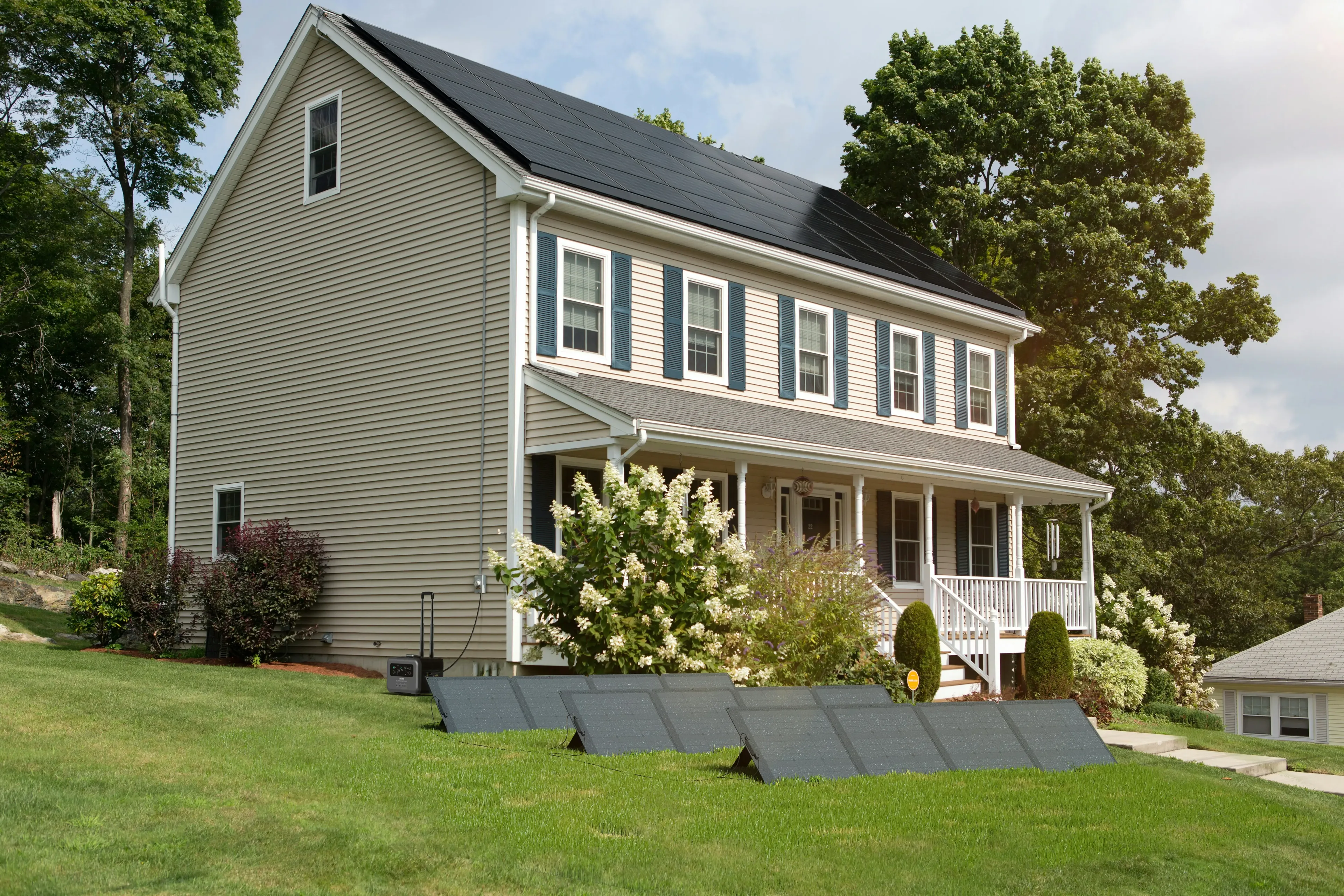
This is image caption.
System Design
Helios worked alongside the builder and architect from the schematic design phase. The roof pitch, orientation, and overhang dimensions were all optimized for solar production before a single panel was specified.
The solar array was the largest residential installation Helios had completed to date, covering the entire south-facing roof surface with high-efficiency panels. A secondary array was added to the west-facing section to capture afternoon sun during the critical summer cooling period.
Battery storage was designed into a dedicated utility room within the home's floor plan. The battery bank was sized to power the entire home through a full overnight cycle and maintain backup capacity for 48 hours without any solar input.
The HVAC system, heat pump water heater, and EV charger were all connected to the solar system's load management controller. During peak production hours, the system automatically directed excess energy to pre-cool the home, heat water, and charge the vehicle - effectively storing energy as thermal mass and vehicle range rather than requiring additional battery capacity.
The design priorities were:
Maximum solar capture through architectural integration
Intelligent load shifting to pre-cool and pre-heat during peak production
Whole-home battery backup with 48-hour autonomy
Zero-compromise comfort with automatic energy management
Installation & Results
Because the energy system was integrated into the construction timeline, installation was completed in phases alongside the build. Electrical infrastructure was laid during framing, battery storage was installed during the mechanical phase, and solar panels were mounted immediately after roofing was complete.
The total system was commissioned and activated on the same day the Nakamuras received their certificate of occupancy. From day one, the home was producing energy.
The first month's results were remarkable. The home produced more energy than it consumed, resulting in a negative electricity bill - a net credit of $38 from the utility company. Over the first full year, the home achieved 96% energy self-sufficiency, with only the deepest winter months requiring minimal grid supplementation.
Annual energy costs totaled approximately negative $280 - meaning the home earned more from grid exports than it spent on the small amount of grid power it consumed. Compared to comparable new builds in the same subdivision without solar, the Nakamuras saved an estimated $4,280 in the first year.
The backup system was tested during a summer grid outage that lasted six hours. The home continued operating at full capacity, including air conditioning, without any noticeable change.
Long-term Performance
The system's performance has exceeded initial projections, partly because the architectural integration allowed for more efficient panel placement than a typical retrofit would permit. The pre-cooling strategy has proven particularly effective, reducing peak evening consumption by shifting cooling loads to midday solar hours.
Helios monitors the system continuously and provides quarterly performance reviews. The Nakamuras' home has become a reference project for the builder, who now offers Helios integration as a standard option for new construction clients.
The system is designed to scale if future needs change. Additional battery capacity can be added without structural modifications, and the electrical panel has reserved capacity for future loads.
For Helios, the Nakamura project represents the future of residential energy. When solar, battery, and building design are coordinated from the start, the result is not just a house with panels on the roof - it is a home that actively works for its owners.
" height="40px" id="mdMoS6e5A" width="60px"/><path d="M 60 0 L 0 0 L 0 20 L 60 20 Z" fill="rgb(191, 10, 48)" height="20px" id="ejGq4Qg70" transform="translate(0 20)" width="60px"/><path d="M 20 0 L 0 0 L 0 40 L 20 40 Z" fill="rgb(0, 40, 104)" height="40px" id="iM3Cv5RpY" width="20px"/><path d="M 2.318 0 L 0 7.133 L 3.566 8.292" fill="rgb(255, 255, 255)" height="8.291999999999998px" id="aiWr2QFHA" transform="translate(7.682 12.5)" width="3.5660000000000007px"/><path d="M 1.249 0 L 3.566 7.133 L 0 8.292" fill="rgb(255, 255, 255)" height="8.291999999999998px" id="kTdO9Sn1s" transform="translate(8.751 12.5)" width="3.565999999999999px"/><path d="M 7.5 0 L 0 0 L 0 3.75" fill="rgb(255, 255, 255)" height="3.75px" id="FoxVq3s8e" transform="translate(9.632 17.682)" width="7.5px"/><path d="M 8.272 0 L 2.204 4.409 L 0 1.375" fill="rgb(255, 255, 255)" height="4.408999999999999px" id="KcVPFqFa4" transform="translate(8.86 17.682)" width="8.272px"/><path d="M 5.884 7.133 L 3.566 0 L 0 1.159" fill="rgb(255, 255, 255)" height="7.132999999999999px" id="KwGJVYnkP" transform="translate(8.524 18.935)" width="5.883999999999999px"/><path d="M 6.068 7.443 L 0 3.034 L 2.204 0" fill="rgb(255, 255, 255)" height="7.443000000000001px" id="pJAyGdKrQ" transform="translate(8.34 18.625)" width="6.068px"/><path d="M 0 7.442 L 6.067 3.034 L 3.863 0" fill="rgb(255, 255, 255)" height="7.442px" id="acy9SWPPg" transform="translate(5.592 18.625)" width="6.066999999999999px"/><path d="M 0 7.132 L 2.317 0 L 5.884 1.158" fill="rgb(255, 255, 255)" height="7.131999999999998px" id="hWwC2Q2HN" transform="translate(5.592 18.935)" width="5.8839999999999995px"/><path d="M 0 0 L 6.068 4.409 L 8.272 1.375" fill="rgb(255, 255, 255)" height="4.408999999999999px" id="hwixRRX5C" transform="translate(2.866 17.682)" width="8.272px"/><path d="M 0 0 L 7.5 0 L 7.5 3.75" fill="rgb(255, 255, 255)" height="3.75px" id="juK2tPA19" transform="translate(2.866 17.682)" width="7.5px"/></g></svg>)
